What Is Riftbound? The League of Legends TCG Explained for Collectors
Riftbound is Riot Games' physical League of Legends trading card game. Here is how it plays, which sets exist, what collectors chase and where Korea fits.
Riftbound is the physical trading card game Riot Games built around League of Legends. It launched in China in August 2025, in English on October 31, 2025, and in Korean on September 18, 2026. You build a deck around one champion, fight over battlefields to score points, and open booster packs that can contain rare alternate-art, overnumbered and artist-signed cards.
If you collect other card games and are deciding whether Riftbound deserves shelf space, this guide covers the parts that matter to a collector: who makes it, how a game works in outline, which sets exist, how the chase cards are structured, and why the Korean edition is worth knowing about.
Who makes it
Riot Games develops Riftbound. Development began in 2023 under game director Dave Guskin and executive producer Chengran Chai. The game was announced in December 2024 under the working name Project K and got its final name in 2025.
Riot does not print and distribute every language itself. UVS Games is the publishing and distribution partner for the English-language release, and Shining Soul publishes the Chinese edition. The Korean edition launched in September 2026 with Riot Games Korea fronting the release and Asmodee Korea named as the organizer or co-organizer of the main Korean tournaments.
How a game works, in outline
You do not need to play Riftbound to collect it, but knowing the card types makes product listings much easier to read.
Each player brings:
- A Legend. This is your champion. It sits outside the deck and decides which two domains your deck can use. Riftbound has six domains: Fury, Calm, Mind, Body, Chaos and Order.
- A main deck of at least 40 cards. These are units, spells and gear. Champion units are the versions of League champions that actually fight on the table.
- A rune deck of 12 cards. Runes are the resource system. They are a separate deck with their own card back, so you never draw a hand with no resources.
- Battlefields. These are the locations players fight over. How many you bring depends on the game mode.
You score points by conquering and holding battlefields, and the first player to reach the target score wins. In a standard one-on-one game that target is 8 points. Riftbound also supports multiplayer formats, which is why the starter box, Proving Grounds, contains four ready-to-play decks.
That structure explains the collecting side. Legends are the face of each deck, so the most valuable printings in the first set are special versions of Legend cards. Champion units come second. Runes get alternate-art versions that are harder to find than their plain look suggests.
The sets so far
Riot releases sets on a schedule of roughly one per quarter. English set codes appear on the collector line at the bottom of every card.
| Set | Code | Main set size | English release |
|---|---|---|---|
| Origins | OGN | 298 | October 31, 2025 |
| Spiritforged | SFD | 221 | February 13, 2026 |
| Unleashed | UNL | 219 | May 8, 2026 |
| Vendetta | VEN | 166 | July 31, 2026 |
| Radiance | RAD | 180 | October 23, 2026 (scheduled) |
Two more sets, Legacy and The Reckoning, are listed for January 29 and April 30, 2027.
Chinese sets originally arrived months ahead of English ones. Origins reached China in August 2025 and Spiritforged in December 2025. Vendetta was the first set to share a single release date across Chinese and English, and Riot has said it plans to keep that going.
All sets produced so far are legal in the Standard Constructed format. Riot's rules hub says rotation of older sets is planned to begin in 2028.
What a booster pack contains
A standard Origins booster holds 14 cards. Riot's Origins collectability article breaks it down as seven commons, three uncommons, two cards that are rare or better, one foil, and one token or rune. English Origins booster boxes hold 24 packs.
Every rare and epic is foil. Epics show up in roughly one pack in four and replace a rare when they do.
Above those sit the cards collectors actually chase:
- Alternate art. In Origins, the champion units of the 12 core champions each have a version showing a different League skin. Riot describes these as appearing up to about twice per box.
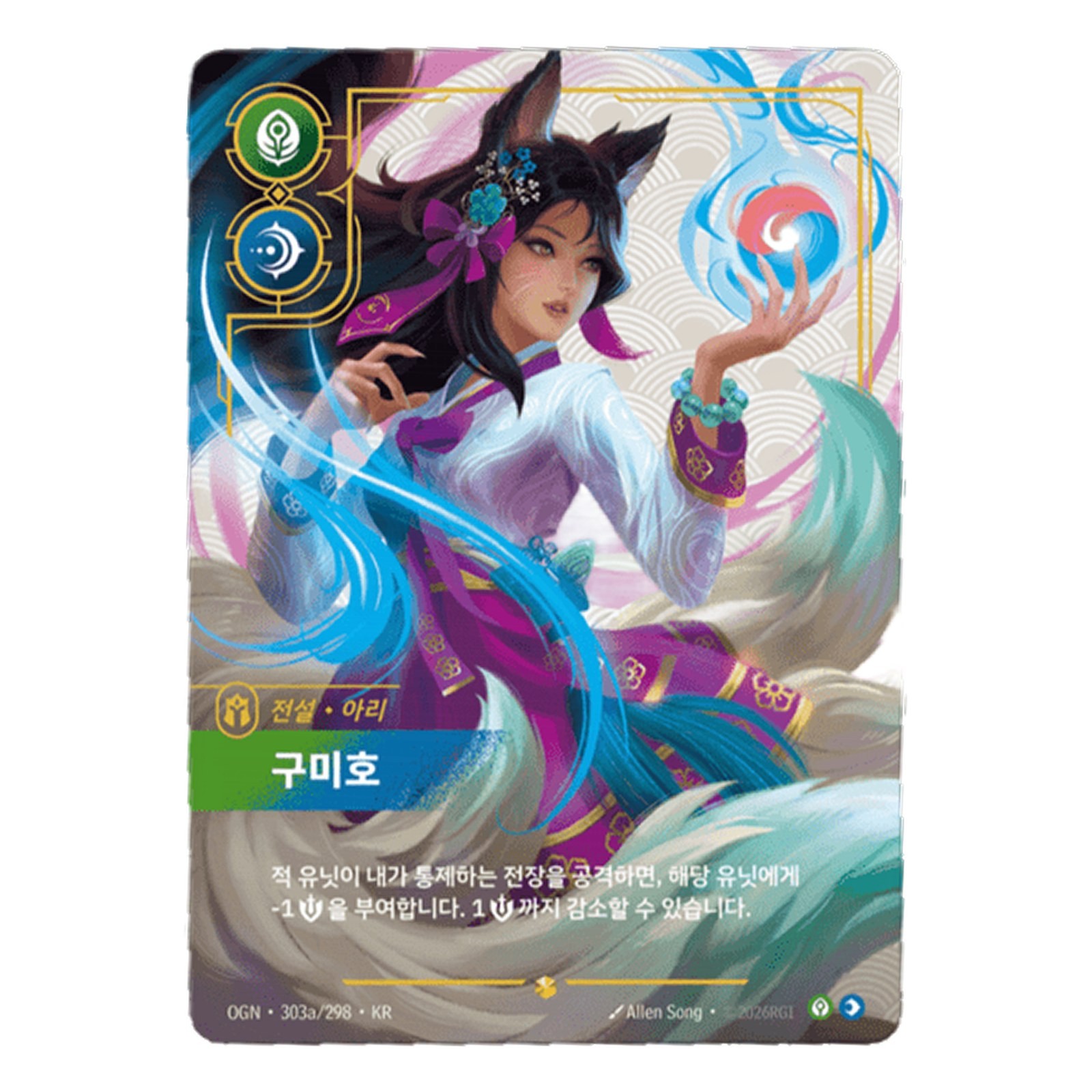
- Overnumbered. Cards numbered past the end of the set, such as 303/298. In Origins these are special versions of the 12 Legends, at roughly one per three boxes.
- Signature. About one in ten overnumbered cards carries the artist's signature in foil. On the collector line these are marked with an asterisk.
- Ultimate. A rarity introduced in Unleashed. Riot says the Ultimate Rare in Radiance averages about 0.025 percent of packs.
Those are averages Riot has published, not guarantees for any box. For the full breakdown, see our guide to Riftbound rarities.
Products you will see for sale
Riftbound product names are consistent across languages, which helps when you are reading a foreign listing.
- Booster packs and booster displays. The randomized product. Korea also sells a five-card Origins booster alongside the 14-card pack.
- Champion Decks. Preconstructed decks. Origins has three: Jinx, Lee Sin and Viktor.
- Proving Grounds. A four-player starter box with four complete decks.
- Vaults and Pre-Rift kits. Later-set products built around storage or pre-release events.
- Collector products. The clearest example is the Riftbound x T1 2025 Worlds Champion Collection, which comes in a serialized Signature Edition and a cheaper Player Bundle. We cover it in a separate guide.
Promo cards
A large share of Riftbound's interesting cards never appear in booster packs. Riot uses promos heavily:
- Nexus Night packs, given for taking part in weekly play at local stores.
- Summoner Skirmish and Regional Qualifier promos, tied to placement at competitive events.
- Launch and convention promos, handed out at events such as Gen Con.
- Judge promos, for people who judge official events.
- Purchase promos, included in specific bundles and box sets.
Promos carry a promo designation at the bottom of the card. Some use new art and some use the regular art with the designation added.
Where Korea fits
Korea got Riftbound almost a year after the English release, and Riot treated the launch as an event in its own right. Three Korean-language cards exist that are not printed in any other language's packs:
- Ahri, Nine-Tailed Fox, a new overnumbered card found only in Korean Origins booster packs.
- Yasuo, Remorseful, a promo with new art by Korean artist Kim Star.
- Jinx, Demolitionist, a promo with a special launch stamp.
Riot has also said it does not plan to put Korea-exclusive cards in boosters often, which makes the Ahri unusual rather than the start of a pattern.
Korea is on a compressed schedule. Spiritforged is due in Korean in December 2026, seven sets are planned for 2027, and Riot is aiming for Korea to match the global calendar at the start of 2028. Our Korean release guide tracks the timeline.
Things to know before you buy
Supply has been uneven. The Origins launch had more demand than product. Riot and UVS Games have since run reprints of Origins and Proving Grounds and have said those reprints will not be the last. If you are paying a premium for sealed first-set product, understand that more of it has been printed since launch.
Early print quality was not perfect. The Origins launch included cards with rough edges and some packs with fewer rares than intended because of a collation error. Riot offered replacements for affected packs. A rough edge on an early Origins card is not, by itself, evidence of a fake.
Language does not affect legality. UVS Games states that official printed cards from any language are legal for Riftbound organized play. A Korean card is a real, playable card in a US store, subject to the usual rules about sleeves and marked cards.
Special printings are not reprinted the same way. Riot has said overnumbered cards will not be reprinted with the same art and border. A reprint of Origins boosters adds more copies of the same cards. It does not create a second version of them.
If Korean-language Riftbound is what you are after, The K Drop ships from Korea to the US with tracking on every order, and you can see what is currently listed on our cards page.
Sources
- Riftbound - Wikipedia
- Korea's Rift Opens on September 18 - Riftbound official site
- Riftbound Origins collectability article, Korean edition - Riftbound official site
- The Radiance Overview - Riftbound official site
- Rules Hub - Riftbound official site
- Riftbound FAQ - UVS Games
- Flash Promos and Origins Reprint Updates - Riftbound official site
- Riftbound promo cards list - Riftbound.gg
Last updated: October 2026.